Introduction
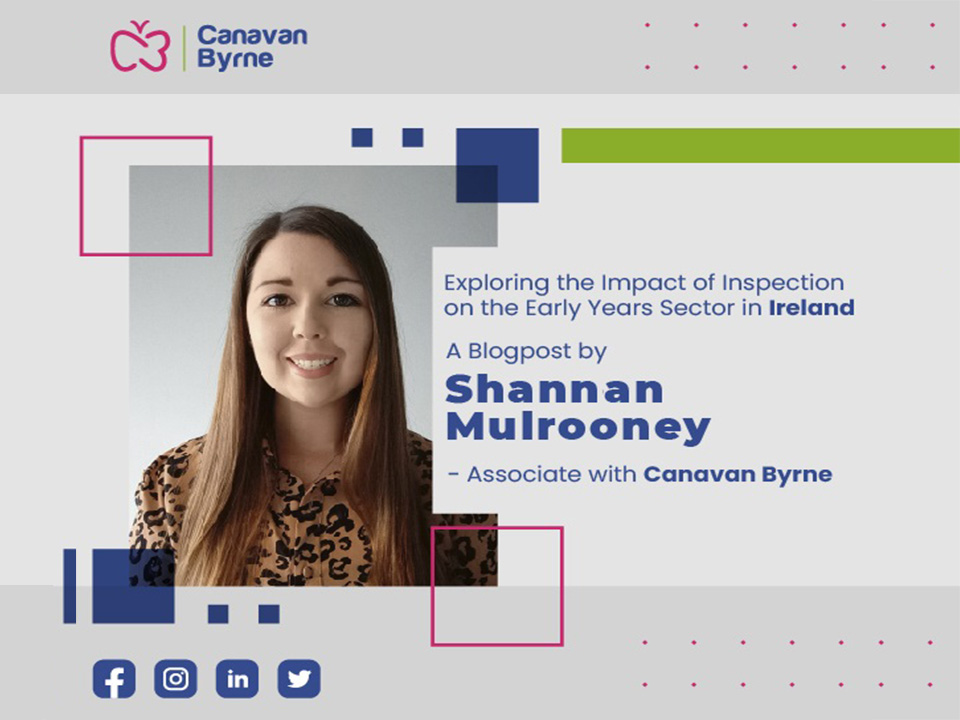
I recently undertook and completed a qualitative research piece to Explore the Impact of Inspection on the Early Years' Sector in Ireland as part of my Masters in Leadership and Advocacy in Early Years. I am delighted to have been asked to share my objectives and findings with Canavan Byrne. While working in the Early Years' sector, I always recognised inspection to be a valuable tool, but having undertaken this research I now have a much stronger understanding of the positive impact inspection can have on the children attending Early Years' services. My aim was to gain further understanding of Early Years' managers' perspectives on the impact of inspection. I believed they could offer valuable insights into how inspection impacts Early Years' services and highlight successful aspects as well as offer suggestions for improvement to further ensure that the children are receiving high-quality experiences in a safe, enriching environment.
Inspection:
The inspection of Early Years' services is crucial to ensure that children's health, safety and well-being is measured and regulated and that services are meeting the regulations and guidelines set out by National policy. It is important to acknowledge that inspection is associated with the government placing an increasing value on Early Years' services and the children who attend. It has been found that investment in the Early Years sector leads to better outcomes for children. However, to achieve this, the Early Years' workforce must follow and successfully implement a child-centered focus in all aspects of their work. Research suggests that inspection is one of the most influential factors in safeguarding children against harmful practices. Furthermore, inspection promotes the application of high-quality standards outlined in the legislation to be applied and reviewed in practice to ensure a consistent, minimum standard of quality in all Early Years' services.
Improved quality of care and learning:
One of the major findings of the study, which is also underpinned by other academic literature, was how inspection resulted in an improved standard of quality within the Early Years' services. The managers discussed a visible improvement in the quality of practitioner-child interactions, the quality of care and play-based learning opportunities offered, improved planning and reflective practices and the quality of the children’s physical environment. To achieve a standard of high quality across the Early Years' sector, it needs to be understood that achieving quality is a process and not merely a checklist; it is a goal always to be extended further beyond where the service is at. It is essential to achieve and maintain consistent, child centered practices which adhere to the regulations, as those who implement child-centered approaches have shown an improvement in the quality of their Early Years’ service.
Importance of regular inspections:
It has been suggested by the Early Years' managers interviewed that more frequent inspections could reap many potential benefits for both the practitioners and children. Managers reported on behalf of themselves and their practitioners that there tends to be a rise in stress levels in the lead up to and during and inspection. The data suggested that those feelings of stress resonated from a lack of experience of inspection. In order to overcome those feelings, more frequent inspections are necessary to familiarise practitioners and managers with inspections and the inspection process. Managers identified the external inspectorate bodies (such as Tusla) to be valuable for guiding them through the process of inspection, addressing and highlighting areas which empower Early Years services to further improve their standards of quality and ultimately benefit the children in their care.
While the inspectorate bodies may not be in a position to facilitate additional inspections, services have the opportunity to run ‘trial’ inspections by experts in compliance, a service regularly utilized through Canavan Byrne. A ‘Mock’ inspection can support and empower the managers and practitioners in a service by allowing them to explore the reality of practice, to learn the standards and receive live feedback. These opportunities are directly linked with the improvement of practice, confidence, and inspection readiness. This takes the form of open dialogue between the Early Years' services and the mock inspector during or after the ‘trial run’ in a feedback session, where there is opportunity to answer questions, address concerns or seek further guidance followed by a detailed report, action plan and/or list of recommendations.
When Early Years' services consistently conform to the regulations and inspection guidelines, it becomes part of their normal practice. Managers and their practitioners begin to understand that meeting the regulations and providing high-quality early childhood care and education is achievable, and in the best interests of the child. They realise that they can do so without feeling the pressure of an imminent inspection.
Conclusion:
Based on the qualitative research I have carried out, which is supported by other academic literature, it can be concluded that the practice of Early Years inspection has led to an improvement in the overall quality of Early Years’ services. The Early Years' managers acknowledged how inspection is at the forefront of their decision making and daily practices. Ultimately, Early Years' services must be operating in line with regulations and inspection guidelines to ensure children's health, safety and well-being at all times. As an advocate for consistency and quality in the Early Years' Sector, I am delighted to engage and work with Canavan Byrne in delivering quality and compliance supports to service providers and their teams.
Share this article